Это русская версия материала. Для полноты языковых маршрутов текст основан на существующей основной версии.
Key Takeaway
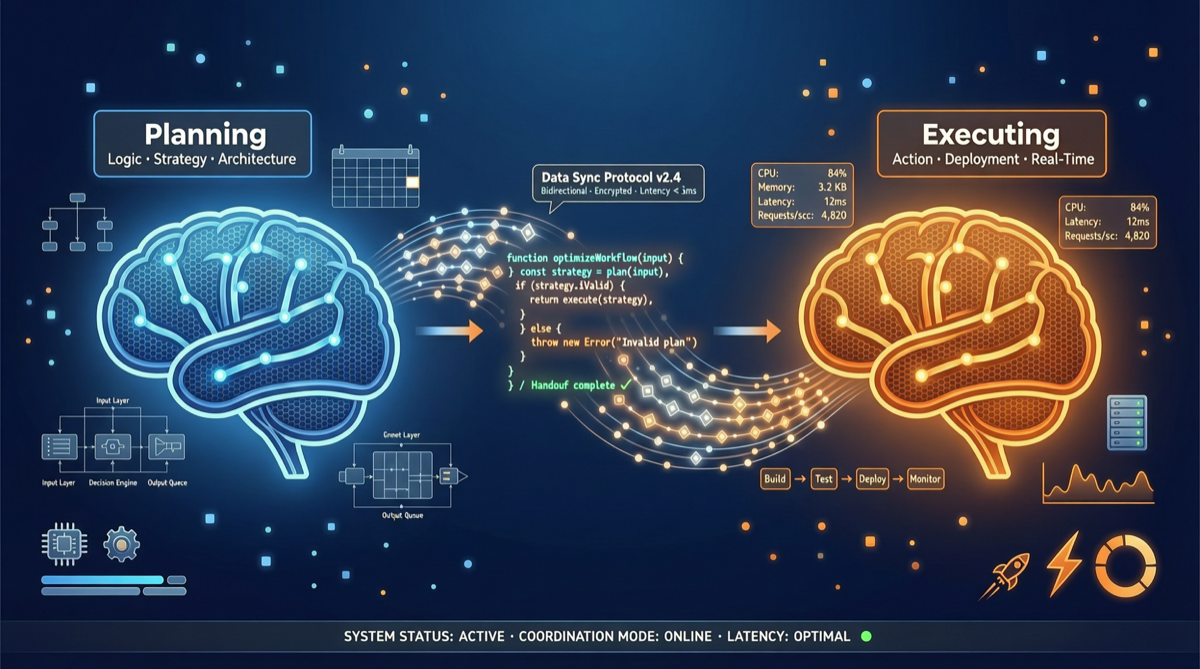
Community testing has validated a counterintuitive finding: the best AI coding workflow isn't about using the single strongest model, but rather letting two models "adversarially collaborate" — Claude Opus 4.7 handles architecture planning and code review, while GPT-5.5 handles code generation and execution. This division of labor doesn't just approach but crushes single-model approaches in coding quality.
Why Dual Models Work
The fundamental problem with single-model approaches is "capability coupling" — the same model must understand requirements, plan architecture, write code, and self-review. This leads to:
- Context pollution: Planning and execution are mixed together, and key decisions get drowned in details
- Self-review failure: Models struggle to detect their own systematic errors
- Style inconsistency: Optimal prompting strategies for different tasks conflict
The dual-model approach solves these problems through "role separation":
| Role | Model | Strength |
|---|---|---|
| Planner | Claude Opus 4.7 | Deep reasoning, architectural thinking, safety review |
| Executor | GPT-5.5 | Code generation speed, API proficiency, Terminal-Bench performance |
Workflow Design
Requirement Input
    ↓
[Opus 4.7] Architecture Planning
    ├── Module decomposition
    ├── Interface design
    ├── Technology selection
    └── Risk assessment
    ↓
[GPT-5.5] Code Execution
    ├── Generate code per module
    ├── Write test cases
    └── Fix compilation errors
    ↓
[Opus 4.7] Code Review
    ├── Architecture consistency check
    ├── Security vulnerability scan
    └── Optimization suggestions
    ↓
[GPT-5.5] Iterative Fix
    ↓
Final Output
Prompt Templates (Condensed)
Planner (Opus 4.7):
You are a senior software architect. Based on the following requirements, output:
1. Module decomposition (no more than 5 modules)
2. Interface definitions for each module
3. Technology selection recommendations with rationale
4. Potential risk points

Requirements: [User input]
Executor (GPT-5.5):
You are a senior software engineer. Please implement code strictly following the architecture specification below:

Architecture Document: [Opus's planning output]

Requirements:
- Generate code only for the specified module
- Include complete type definitions
- Write a docstring for every function
Reviewer (Opus 4.7):
Please review whether the following code implementation aligns with the original architecture plan:
1. Any architectural deviations
2. Security vulnerabilities
3. Code quality score (1-10)

Architecture Plan: [Original plan]
Code Implementation: [GPT's code output]
Cost Analysis
| Approach | Estimated Cost per Task | Quality |
|---|---|---|
| Opus 4.7 only | $0.80 | High |
| GPT-5.5 only | $0.30 | Medium |
| Dual-model workflow | $0.60 | Highest |
The dual-model approach costs between the two single models but delivers the highest quality. The key insight: the planner and reviewer consume far fewer tokens than the executor — Opus outputs structured planning documents, not full code.
Comparison with Existing Approaches
| Approach | Pros | Cons |
|---|---|---|
| Single model (Opus/GPT) | Simple, low cost | Low quality ceiling |
| Multi-model parallel routing | Auto-selects optimal model | Still single-turn calls |
| Dual-model adversarial collaboration | Highest quality | Requires orchestration infrastructure |
| Agent Harness (jcode, etc.) | High automation | Complex configuration |
When to Use the Dual-Model Workflow
Recommended for:
- Complex project architecture design
- Production code requiring high reliability
- Security-sensitive modules (authentication, payments, etc.)
- Code review and refactoring
Not recommended for:
- Simple scripting
- Prototype development (speed-first)
- Extremely budget-constrained scenarios
Automation Path
Manually orchestrating the dual-model workflow is feasible but tedious. Automation directions include:
- jcode / Agent Harness: Existing projects support multi-model orchestration, ready to configure
- n8n workflows: Connect Claude and OpenAI APIs via MCP to build automated pipelines
- Custom scripts: Use Python scripts to chain two API calls at the lowest cost
Industry Signals
The popularity of this workflow reflects a larger trend: in 2026, the AI coding competition has shifted from "which model is strongest" to "how to orchestrate multiple models."
As the community puts it: "Model Quality is becoming a commoditized topic. The real moat lies in Agentic workflows, trust evaluation for tool usage, and the speed of model switching."
Dual-model adversarial programming is an early practice of this trend — it doesn't pursue a single model's perfection, but maximizes the value of existing models through system design.